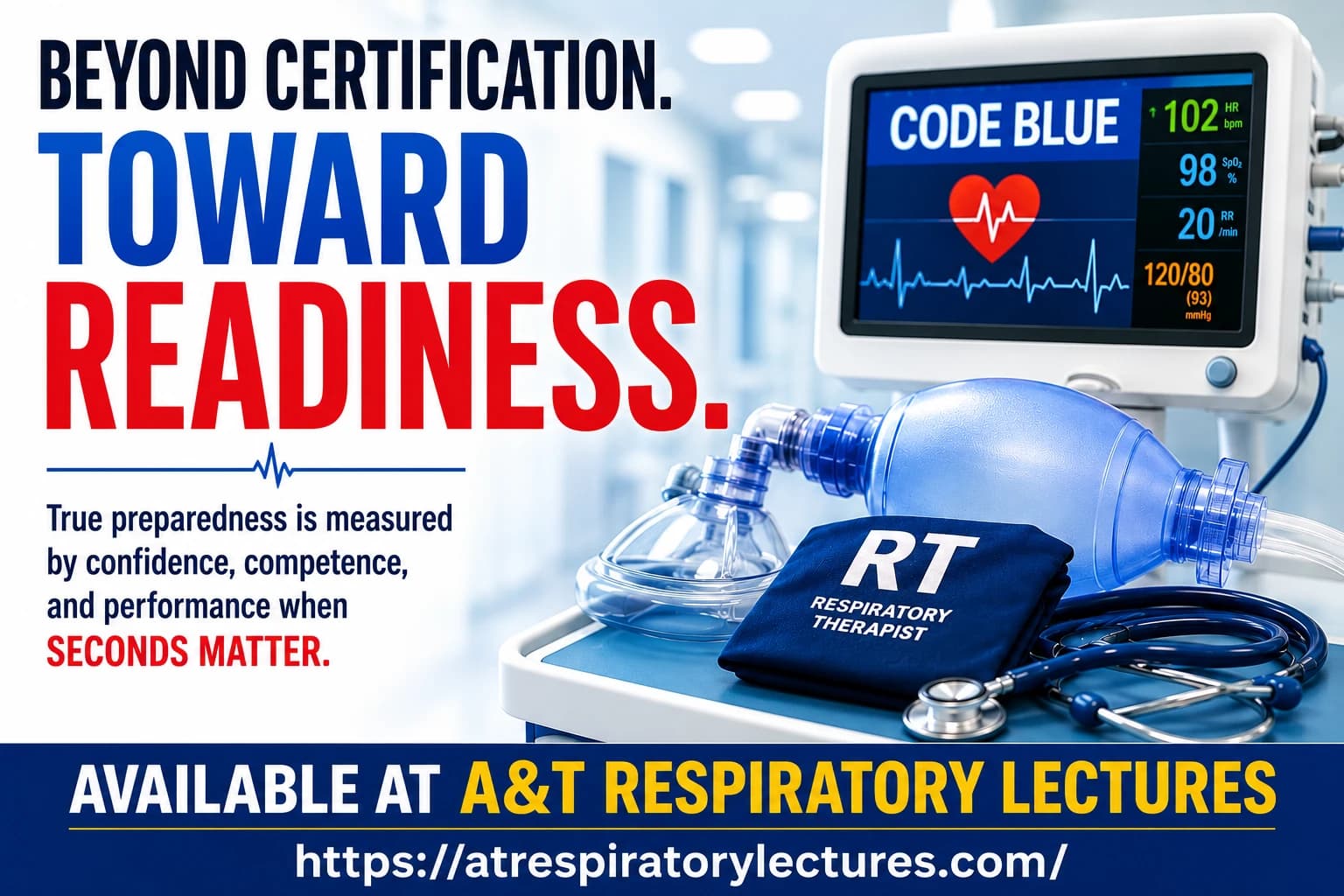
Respiratory therapists play a critical role during high-acuity hospital events, including code blues, rapid response activations, emergency intubations, patient deterioration scenarios, and post-cardiac arrest care.
Yet many healthcare organizations measure certification status rather than true readiness.
Advanced Cardiac Life Support (ACLS) certification remains an essential requirement for many respiratory therapists. However, completing a certification course does not necessarily ensure clinicians feel prepared to perform their responsibilities confidently and effectively when seconds matter most.
For hospital executives, respiratory therapy directors, clinical educators, and quality leaders, the question is no longer whether staff maintain ACLS certification.
The more important question is:
How do we know our respiratory therapists are truly prepared for high-acuity events?
Defining Code and Emergency Response Readiness
Code and Emergency Response In-Hospital Readiness refers to a respiratory therapist's ability to effectively perform role-specific responsibilities during emergencies, including:
-
Airway management
-
Ventilation optimization
-
Waveform capnography interpretation
-
RT-specific rhythm recognition
-
Equipment preparation and troubleshooting
-
Team communication
-
Post-cardiac arrest ventilator management
-
Role clarity during emergencies
Readiness extends beyond knowledge acquisition.
It reflects a clinician's ability to perform under pressure in dynamic, time-sensitive environments.
Competence involves more than understanding algorithms. It requires translating knowledge into action while communicating effectively within interdisciplinary teams.
The Transition-to-Practice Challenge
Research suggests that new graduate respiratory therapists frequently experience stress and uncertainty during their transition to independent practice.
Common challenges include:
-
High-acuity patient assignments
-
Limited exposure to emergency scenarios
-
Balancing multiple competing priorities
-
Developing confidence during code events
-
Navigating complex interdisciplinary environments
These concerns are not unique to respiratory care. Similar findings have been reported across nursing, medicine, and allied health professions.
Studies consistently demonstrate that simulation, mentorship, structured onboarding, and role-specific education can improve confidence, communication, and performance during emergency situations.
While experience remains an essential teacher, structured educational interventions may help accelerate readiness and reduce uncertainty during the early stages of clinical practice.
The Reality of Respiratory Care Workflows
Respiratory therapists rarely have the luxury of uninterrupted time for professional development.
Instead, they spend their shifts moving rapidly between competing responsibilities, including:
-
Scheduled respiratory therapies
-
Ventilator management
-
Arterial blood gas analysis
-
Patient transports
-
Rapid response activations
-
Emergency airway management
-
High-flow and noninvasive ventilation support
-
Documentation requirements
-
Family education
-
Interdisciplinary communication
Many therapists work within a continuous cycle of patient care tasks that leaves limited time for simulation, mock codes, continuing education, and skills validation.
This is not a lack of commitment.
It is a bandwidth challenge.
If organizations expect respiratory therapists to perform effectively during high-acuity events, they must create opportunities for structured education and protected learning time.
Why Readiness Matters
No single educational intervention can fully prepare a respiratory therapist for every emergency.
Readiness develops through a combination of:
-
Department orientation
-
Mentorship
-
Simulation
-
Competency assessment
-
Continuing education
-
Real-world experience
Role-specific education may serve as a foundational component of that process.
As respiratory therapists become more familiar with their responsibilities during high-acuity events, they may develop greater situational awareness, communicate more effectively within interdisciplinary teams, and recognize critical changes in patient status earlier.
Over time, increased confidence and role clarity can help accelerate the development of essential clinical skills.
Investing in readiness benefits more than the individual clinician.
Potential organizational benefits include:
-
Increased respiratory therapist confidence during emergency events
-
Improved role clarity and team communication
-
Greater consistency in respiratory care practices
-
Enhanced onboarding experiences
-
Improved staff engagement and professional development
-
Increased retention of early-career therapists
-
Stronger patient safety culture
-
More standardized emergency response processes
Ultimately, preparedness is not solely the responsibility of the individual therapist.
It is a shared commitment between clinicians, respiratory therapy leadership, and hospital administration.
Measuring What Matters
Organizations routinely track certifications and annual competencies.
Few formally measure Code and Emergency Response In-Hospital Readiness.
Potential metrics include:
-
Pre- and post-training confidence surveys
-
Mock code performance scores
-
Time to airway intervention
-
Waveform capnography utilization rates
-
Post-cardiac arrest ventilator management compliance
-
Orientation completion time
-
Annual competency assessment results
-
Staff retention and engagement metrics
Asking a simple question can provide valuable insight:
"How confident are you performing your role during a code blue event?"
Tracking responses before and after educational interventions may help leaders identify opportunities for improvement and evaluate program effectiveness.
Where RT-ACLS Fits
RT-ACLS First Edition (2026) was developed to complement standard ACLS by focusing on the respiratory therapist's responsibilities during in-hospital emergencies.
Core topics include:
RT-ACLS is not intended to replace standard ACLS, department orientation, simulation programs, mentorship, or clinical experience.
Rather, it was designed to serve as a structured educational tool that organizations may incorporate into onboarding programs, residency initiatives, annual competencies, and professional development plans.
As part of a broader readiness strategy, RT-ACLS may help support confidence, reduce uncertainty, and strengthen Code and Emergency Response In-Hospital Readiness.
Creating Time for Readiness
Providing protected time for continuing education, simulation, mock codes, and RT-specific training demonstrates an organization's investment in both its workforce and its patients.
Readiness requires intention.
It requires dedicated resources.
Most importantly, it requires recognizing that certification alone does not equal preparedness.
When healthcare organizations invest in respiratory therapist readiness, everyone benefits:
-
The therapist gains confidence and role clarity.
-
The department improves consistency and teamwork.
-
The facility strengthens emergency response capabilities.
-
Patients receive care from clinicians who are better prepared for high-acuity situations.
The question for hospital and respiratory therapy leaders is not whether respiratory therapists are busy.
The question is whether organizations are creating the time and resources necessary to ensure readiness when emergencies occur.
Because when seconds matter, preparedness matters.
Call to Action
Explore how RT-ACLS First Edition (2026) can complement your organization's onboarding, competency assessment, simulation, and professional development initiatives.
Learn more through A&T Respiratory Lectures and discover additional RT-ACLS educational resources focused on airway management, waveform capnography, ventilation optimization, and post-cardiac arrest care.
RT-ACLS First Edition (2026) Copyright © 2026 Gary DiLorenzo and Breathe Deep Institute. All Rights Reserved.
Disclaimer: RT-ACLS First Edition (2026) is an educational resource designed to complement, not replace, standard ACLS certification, institutional policies, clinical judgment, simulation programs, or employer-specific competency requirements.