



Copyright © 2026 A&T Respiratory Lectures All Rights Reserved
Managing patients with acute respiratory failure in the Intensive Care Unit (ICU) requires precision, deep physiological understanding, and the right data. When you treat patients battling Acute Respiratory Distress Syndrome (ARDS) or severe pneumonia, balancing adequate oxygenation with lung-protective ventilation is your primary goal. Pushing too much pressure can cause Ventilator-Induced Lung Injury (VILI), while providing too little support leaves the patient dangerously hypoxemic.
To navigate this delicate balance, respiratory therapists and critical care physicians rely on specific physiological metrics. Two of the most discussed metrics for assessing patient severity and guiding mechanical ventilation are the Oxygen Index (OI) and the Oxygen Stretch Index (OSI).
But which one is better for managing a patient in the ICU?
In this comprehensive guide, we will break down the physiology, clinical applications, and core differences between these two vital metrics. By understanding how to accurately interpret a patient's oxygen status, you can make better clinical decisions, optimize ventilator settings, and ultimately improve patient survival rates.
Before diving into complex indices, we must look at how we traditionally evaluate a patient's oxygen status. For decades, the standard benchmark for ARDS severity has been the PaO2/FiO2 ratio (the P/F ratio). The Berlin Definition of ARDS relies heavily on the P/F ratio to classify disease severity as mild, moderate, or severe.
However, the P/F ratio has a significant blind spot. It tells you the efficiency of oxygen exchange, but it tells you absolutely nothing about the mechanical cost required to achieve that exchange. A patient might have a P/F ratio of 150 on a Positive End-Expiratory Pressure (PEEP) of 5 cm H2O, while another patient might have the exact same P/F ratio requiring a PEEP of 18 cm H2O and highly aggressive peak airway pressures. Clearly, these two patients have vastly different levels of lung injury, yet the P/F ratio treats them the same.
To get a complete picture of a patient's oxygen status, we must combine gas exchange metrics with the mechanical pressures used by the ventilator. This is exactly where the Oxygen Index and the Oxygen Stretch Index come into play.
If you want to deepen your understanding of these vital respiratory concepts, we highly recommend attending Live AARC-Approved Respiratory Therapy Webinars to stay updated on the latest evidence-based practices in critical care.
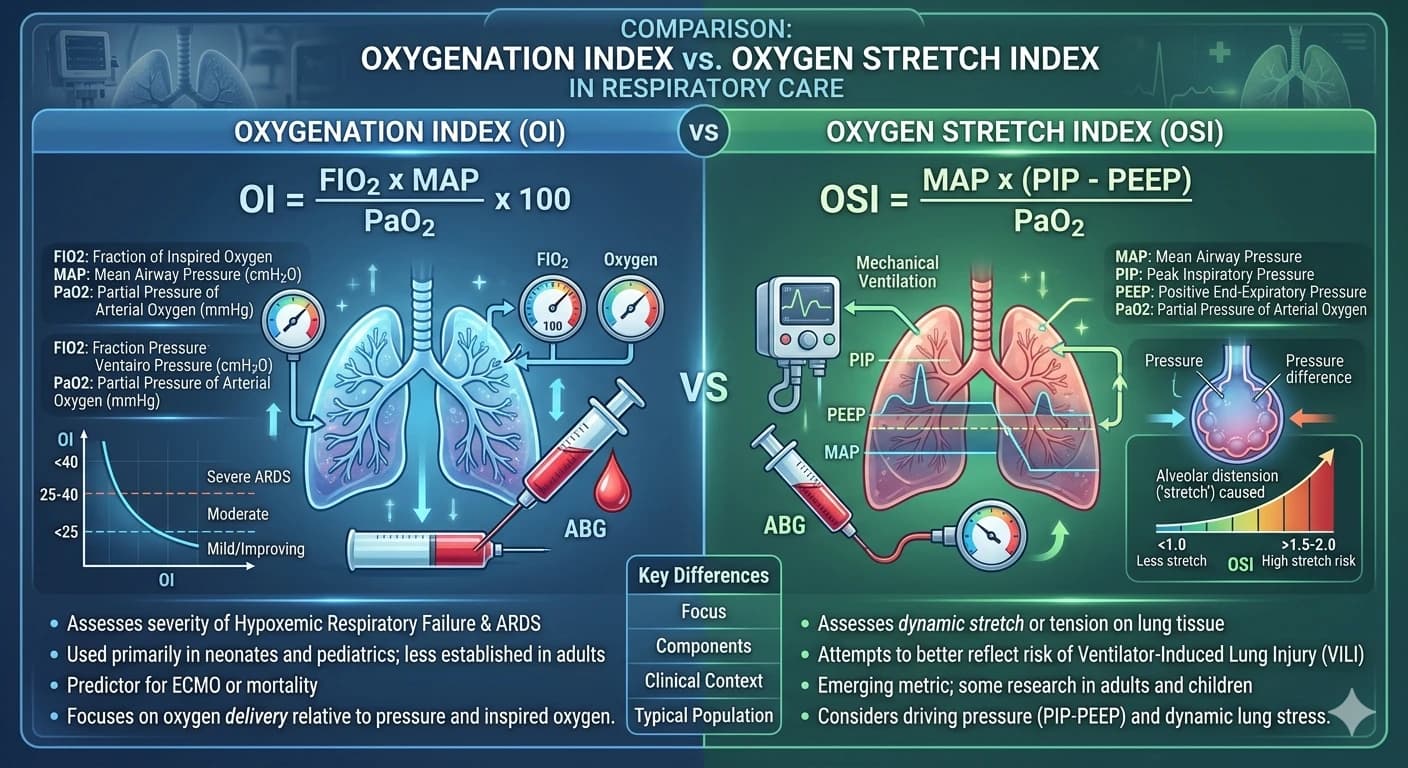
The Oxygen Index is a powerful metric traditionally used in neonatal and pediatric intensive care to quantify the severity of hypoxemic respiratory failure. It improves upon the P/F ratio by factoring in the Mean Airway Pressure (MAP) required to achieve a specific level of arterial oxygenation.
By incorporating MAP, the Oxygen Index reflects the "cost" of ventilation. If you have to increase the airway pressure to maintain the same oxygen level, the patient's Oxygen Index will worsen, accurately reflecting a decline in their clinical condition.
To calculate the Oxygen Index, you need three variables:
The standard oxygen index equation is:
OI = (FiO2 × Mean Airway Pressure × 100) ÷ PaO2
Note: In this formula, FiO2 is used as a decimal, and the result is multiplied by 100. Alternatively, if FiO2 is used as a whole number percentage, you omit the multiplication by 100.
The Oxygen Index is widely validated in the pediatric and neonatal populations. It serves as a crucial trigger point for escalating therapy. For instance:
Because the OI utilizes Mean Airway Pressure, it accounts for both the inspiratory and expiratory pressures over the entire respiratory cycle. This makes it an excellent tool for assessing overall oxygenation efficiency and guiding early, aggressive interventions in younger patients.
While highly effective in pediatrics, the Oxygen Index has limitations when applied to adult ICU patients. Mean Airway Pressure does not directly correlate with lung strain or the risk of VILI. Adults with ARDS often face significant issues with lung compliance and overdistension. The Oxygen Index does not differentiate between a high MAP driven by a high PEEP (which might be protective and recruit lung units) and a high MAP driven by a high plateau pressure (which causes dangerous overdistension).
To master nuanced concepts like these and elevate your clinical practice, explore the Comprehensive Online Courses by A&T Respiratory Lectures | Explore Topics in Respiratory Care.
As respiratory medicine evolved, researchers and clinicians recognized that evaluating oxygenation without assessing dynamic lung strain left adult patients vulnerable to ventilator-induced trauma. This realization led to the development of the Oxygen Stretch Index (OSI).
The oxygen stretch index shifts the mechanical focus from Mean Airway Pressure to Driving Pressure (ΔP). Driving pressure is calculated as the Plateau Pressure minus the PEEP (ΔP = Pplat - PEEP).
Extensive research demonstrates that driving pressure is one of the strongest independent predictors of mortality in patients with ARDS. It represents the cyclic strain applied to the lung tissue with every single breath. By combining the P/F ratio with driving pressure, the oxygen stretch index paints a highly accurate picture of both gas exchange and mechanical strain.
The formula for calculating the Oxygen Stretch Index evaluates the trade-off between oxygenation and the driving pressure required to achieve it:
OSI = (PaO2 / FiO2) ÷ Driving Pressure (ΔP)
A lower OSI indicates a worse clinical condition. It means the patient is achieving poor oxygenation despite being subjected to high, damaging driving pressures.
The OSI has gained massive traction in adult ICUs, particularly during the COVID-19 pandemic. Patients with COVID-19 ARDS frequently present with atypical compliance phenotypes. Some patients require high oxygen delivery but maintain relatively normal lung compliance, meaning their driving pressures remain low. Others experience classic, "stiff" ARDS lungs requiring high driving pressures to deliver tidal volumes.
By utilizing the oxygen stretch index, clinicians can easily identify which patients are at the highest risk of lung injury. Applications include:
Now that we understand both metrics, we must address the core question: Comparing oxygen index with oxygen stretch index, which one is better for managing a patient in the Intensive Care Unit?
The answer depends heavily on the patient population, the specific goals of ventilation, and the primary disease pathology. Let us compare them across several clinical domains.
Winner: Oxygen Stretch Index
The primary cause of mortality in ARDS is often not hypoxemia itself, but the secondary multi-organ failure driven by the inflammatory cascade of Ventilator-Induced Lung Injury. The OSI directly incorporates driving pressure, which is the undisputed gold standard for measuring cyclic lung strain. The Oxygen Index uses MAP, which fails to distinguish between safe, static pressures (PEEP) and dangerous, dynamic pressures (plateau pressure). For minimizing VILI in adults, the OSI is far superior.
Winner: Oxygen Index
If you are working in a neonatal or pediatric intensive care unit, the Oxygen Index remains the undisputed champion. It has decades of validated research establishing precise clinical thresholds. An Oxygen Index greater than 40 is a universally understood trigger for ECMO evaluation. The OSI is still primarily a research metric in this regard and lacks universally standardized cutoffs for initiating rescue therapies.
Tie
Both indices require an arterial blood gas to measure PaO2. However, they both utilize data readily available on any modern mechanical ventilator. You can easily calculate the oxygen index equation using the MAP displayed on the ventilator screen. Similarly, by performing a quick inspiratory hold to obtain a plateau pressure, you can easily calculate driving pressure and determine the oxygen stretch index. Both are practical for routine bedside assessments.
Winner: Oxygen Stretch Index
The COVID-19 pandemic highlighted the critical importance of measuring compliance alongside oxygenation. Many patients presented with "happy hypoxia," showing severe hypoxemia but highly compliant lungs. Treating these patients based solely on oxygenation often led to inappropriately high PEEP levels, causing hemodynamic instability and lung overdistension. The OSI forces the clinician to evaluate the driving pressure, ensuring that ventilator settings are tailored strictly to the patient's specific mechanical needs.
Continuous education is the key to managing complex pathologies like COVID-19 ARDS. You can expand your expertise by joining Live AARC-Approved Respiratory Therapy Webinars, which offer deep dives into advanced ventilation strategies from the comfort of your home.
To truly elevate your practice, you should not view these indices as mutually exclusive. The best respiratory therapists and critical care physicians utilize a multidimensional approach to assess oxygen status.
When a patient is admitted to the ICU and intubated for respiratory failure, immediately perform a baseline assessment. Calculate the P/F ratio to classify their ARDS severity. Next, calculate the Oxygen Index to understand the overall pressure cost of their oxygenation. Finally, calculate the Oxygen Stretch Index to evaluate their baseline lung strain. Documenting these three values provides a comprehensive snapshot of their respiratory health.
As you adjust the ventilator, watch how these indices respond.
If the OSI improves, your PEEP titration was successful. If the OSI worsens, you are increasing the risk of VILI, and you should reconsider your settings.
As the patient recovers, both indices should steadily improve. A decreasing Oxygen Index and an increasing Oxygen Stretch Index signal that the lung is healing, compliance is returning, and the patient requires less mechanical support to maintain adequate oxygenation. This gives you the confidence to begin weaning pressure support and conducting spontaneous breathing trials.
The integration of advanced metrics like the Oxygen Stretch Index represents a significant shift in critical care medicine. We are moving away from simplistic, one-dimensional targets (like maintaining a specific SpO2) and embracing a holistic view of lung mechanics and gas exchange.
Modern ventilators and integrated clinical decision support systems are beginning to automate these calculations. In the near future, you will likely see the Oxygen Index and Oxygen Stretch Index displayed continuously on the ventilator interface alongside mechanical power and compliance trends. This real-time data will empower you to make proactive, rather than reactive, decisions.
However, technology is only as good as the clinician interpreting the data. It is vital that you understand the physiological principles behind the oxygen index equation and driving pressure. To build this foundation, take advantage of the Comprehensive Online Courses by A&T Respiratory Lectures | Explore Topics in Respiratory Care. These courses are designed to transform your clinical approach and help you master the complexities of critical care ventilation.
So, comparing oxygen index with oxygen stretch index, which one takes the crown?
Ultimately, the OSI provides a more mechanically sound framework for managing adults in the ICU, while the OI remains the gold standard in pediatric care. By mastering both metrics, you ensure that you are fully equipped to protect your patients' lungs while providing the life-saving oxygen they desperately need.
Unlock your respiratory expertise and continue growing your clinical toolkit today. Your patients depend on your knowledge, precision, and dedication to excellence.
Respiratory care changes fast. At A&T Respiratory Lectures, we want to help you stay ahead.
Our articles are great for everyone. Experienced therapists use them to improve patient care. Newcomers use them to grow their careers. We provide the tools you need to succeed.